Adam Goodman on Yourmoneyradio.ca!
 August 3, 2010


I was recently interviewed by Greg Bohnert from yourmoneyradio.ca. The interview was aired on several radio stations in Western Canada as well as on the yourmoneyradio.ca podcast. The interview is about 16 minutes in length and covers some great topics from how to talk to young people about money to money management tips. You can listen to the podcast below (the interview starts at 10:50 into the clip), as well as check out the promo video. Also, if you haven’t visited yourmoneyradio.ca before, you should go check it out – they have a weekly podcast with a different guest each week.
Interview:
Audio clip: Adobe Flash Player (version 9 or above) is required to play this audio clip. Download the latest version here. You also need to have JavaScript enabled in your browser.
Promo Video:
http://www.followingthegoods.com/wp-content/uploads/2010/08/yourmoneyradio-video.flv
Have you bought your copy of Following The Goods? Buy it today!

 Tags:
Tags: Merchant Bankers Described by Monty Python
Watch the clip below, a good laugh for a Monday night….

Have you bought your copy of Following The Goods? Buy it today!
Adam Goodman Interviewed on Investment Executive TV
I was recently interviewed by Megan Harman for Investment Executive TV on how financial professionals can connect with the millennials . You can watch the video below, and click here to read the full article.
http://www.followingthegoods.com/wp-content/uploads/2010/04/investmentexecutive video.flv
Have you bought your copy of Following The Goods? Buy it today!
Adam Goodman Interview in The Globe and Mail
In case you missed it, Saturday’s edition of the Globe and Mail had an interview with me for  the Me and My Money column (Business Section, B8). You can read the entire interview here.
If you could give one piece of investment advice, what would it be? Click here to post your thoughts in the comments section!
Have you bought your copy of Following The Goods? Buy it today!
Adam Goodman Interviewed in Investment Executive
I was recently interviewed in the Investment Executive. The article discusses a recent study from StatsCan showing that students are facing larger student debts – it’s a worthwhile read, so go check it out!
From the article…
A recent Statistics Canada report reveals 57% of the graduating class of 2005 had student loans, up from 49% a decade earlier. Average student debt upon graduation rose to $18,800 from $15,200, and the proportion of borrowers who graduated with debt loads of at least $25,000 increased to 27% from 17%.
Furthermore, the StatsCan study shows a substantial gap in wealth levels between those who borrowed and those who didn’t. In 2005, the average amount of assets of post-secondary graduates aged 20 to 29 who had borrowed money was $60,700, compared with $106,300 for those who hadn’t taken out loans
Do you know anyone with student debt? What are your thoughts on the rising amount of debt students are facing? Comment below!
Have you bought your copy of Following The Goods? Buy it today!
Debt Free Now What?
The article below was published in Canadian MoneySaver magazine in January 2010
An amazing thing happened to me recently and it has had a huge impact on my life. I paid off my $60,000 student debt. This was no easy task. In order to get to a zero balance, I chose to sacrifice my social life on many occasions, whether it was staying in for the evening instead of going out or not being able to fly to the Caribbean for a good friend’s wedding.
After months of turmoil watching my social life putter to a halt and questioning whether minimizing my fun to maximize my ability to save was really worth it, I received a bank statement which showed my loan balance at $0 – which is now sitting in a frame on my wall- and my answer is yes; it was worth it. The question I’m now faced with is what next? For the first time in years, I have no significant financial commitments. For a brief moment, I am what is called “financially free,” but not for long. So how does one decide what to do next?
In my first article, I talked about thinking about the future. In this article, I’m going to take you through an exercise to quantify your lifestyle goals and how to measure them against your current income. As for me, I’ve started to think about the life I want, and how I’m going to get there financially. By thinking about the big picture and what that entails, I can start to work backwards and create the starting point for a financial plan on how I’m going to get what I want. The purpose of creating a financial plan is to provide you with guidelines that will help shape your decisions.
So how do you think about the future? The first step is to visualize the type of life you want. In my case, I know the following things are important to me:
- Travel abroad once per year (it’s important for me to see the world)
- Live on my own
- Have a car
- Be able to go out for dinner once per week (I’m a foodie and need to try new foods)
- Be able to go out with friends socially once per week (it’s important to stay in touch with friends)
- Start saving to for a down payment on a house (I can’t afford to buy a house today, but I want to work towards buying a house)
- Be physically active (including tennis and golf)
- The ability to buy new technology twice per year (I’m also a techie and want to be able to buy new toys)
- Wardrobe replenishment twice per year (I usually only go shopping twice a year, but each time it’s a big one)
Now that I’ve put my lifestyle goals down on paper, I can quantify what this lifestyle will cost with ballpark dollar values beside each item. If you don’t know how much something will cost, do a preliminary search on the internet or ask friends and family to help flush out the costs.

In my case, for me to achieve my lifestyle goals, I’m going to need to find $48,200 after tax each year, not including other costs like cell phones, food, investing for the future and miscellaneous costs. If my current salary is not at that level, I’m going to have to either find additional money to cover the shortfall or consider cutting back on some of the expenses above. After you calculate what your lifestyle goals will cost, compare them to your current after tax income see if there is a shortfall between how much you make and how much you want to spend.
The final step in this exercise is to put a plan in place to meet your lifestyle goals by figuring out how much you need to save each pay period. The following will show you how to calculate this. In my case, I get paid every two weeks, so I need to take each expense above and divide it by 26 (which represents the number of pay periods each year) to determine how much of each pay check I need to save for that expense.
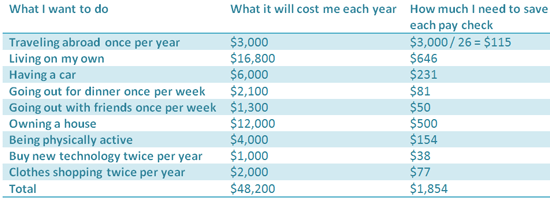
Now that I’ve demonstrated how to calculate how much to save each month to obtain your lifestyle goals, you need to start putting your money aside. For monthly expenses such as living on your own and having a car, you can setup an automatic withdrawal to make payments from your checking account each month. This will make sure that you’re paying your monthly bills on time. The rest of your expenses happen on a less regular basis, so you can put those into a savings account – in fact, some banks will let you set up a savings account for each item you want to save for. In my case, I would setup a savings account for clothes, owning a house, travel, and technology.
By thinking about your lifestyle goals and putting down all the costs on paper, you’ll have a clear picture of how much money you need to set aside to live that life.
Have you bought your copy of Following The Goods? Buy it today!
And the Winner Is…..
The $50 Amazon.ca gift card giveaway is over! I’ll be sharing the results of the survey over the next few week s, but wanted to announce the winner.
Contratulations goes to chickeechickee! You’ll be receiving your gift card shortly.
Thanks to everyone who entered, and if you didn’t enter but still want to fill out the survey, this is your chance!
Have you bought your copy of Following The Goods? Buy it today!

How Long Will it Take to Pay Off Your Credit Card Debt?
One item which most young people aren’t aware of is how costly it can be to carry an active balance on your credit card. It’s really important to pay off your credit card debt as soon as possible so you don’t end up paying heavy interest fees.
The Investor’s Education Fund recently launched a site to tell you just how long it will take you to pay off your credit card debt. For example, if you have $2,000 in outstanding debt on your credit card and are charged an interest rate of 19.9%, and can only afford a $300/month payment, it will take you 8 months to pay off your debt.
Yes, that’s right; to pay off your $2,000 debt you’ll end up paying the credit card company $2,400, of which $400 is interest fees.
So if you don’t have a plan to pay off that credit card debt today, maybe you should head on over here and figure out how you’re going to get that credit card balance to zero!
Don’t forget, there are only 2 days left until the $50 Amazon gift card contest is over, and all it takes is 3.5 minutes to enter!!!
Have you bought your copy of Following The Goods? Buy it today!
How Would You Save Differently?
For most of you, retirement is a long time away, but it never hurts to start thinking about it (after all, the sooner you start thinking and planning, the more you’ll have). Bank of America recently released a survey asking people close to retirement what their biggest concerns are, and what they would have done differently if they could plan for the future again.
Some interesting tidbits are:
- 51% of respondents wish they would have focused more on “life goals” than on “the numbers”
- 38% wished they had spent more time thinking about how they want to live rather than hitting a specific retirement number
- 18% would have given up on certain luxuries in order to reach their retirement goals
- 31% of respondents worked with a financial advisor, and 55% wished they would have worked with one
In terms of advice for younger generations, survey respondents recommended that if you are 10-15 years away from retirement you should:
- build a plan around what is most important to you
- have a plan to manage retirement income throughout retirement
- pay down debt
There is also a short write up of the survey on the Money Bucks website.
Don’t forget, there are only 2 weeks left until the $50 Amazon gift card contest is over, and all it takes is 3.5 minutes to enter!!!
Have you bought your copy of Following The Goods? Buy it today!
Complete A Short Survey and You Can Win $50
Start the year off right by entering to win a $50 gift certificate from Amazon! Take five minutes to fill out a short survey and you will automatically be entered into a draw to win a $50 gift certificate. The draw will take place on January 28th, 2010 and the winner will be notified on January 29th, 2010.
Click here to take the survey, or find out more information below.
Why is Adam conducting a survey?As part of my quest to help young people take an interest and start managing their money, I’m trying to better understand the issues preventing them from achieving financial stability.
Will my results be shared? No. All results will be kept confidential and only aggregate results will be shared.
Will you share the overall results with me? Yes, the aggregate survey results will be published on Followingthegoods.com for everyone to see.
How will I know if I win? The winner will be contacted via email on January 29, 2010, and the gift certificate will be delivered by email.
Do I have to enter my email address? Yes. If you want to claim your prize, you must enter a valid email address. Remember, your individual results will never be shared, and no one will ever find out what you answered.
Can anyone enter the contest? Yes, anyone can enter the contest by filling out the survey below. Please note, you must answer all questions in the survey to be eligible to win the gift certificate.
Where is the survey? Click here to take the survey and enter to win $50 at Amazon!
Have you bought your copy of Following The Goods? Buy it today!
Adam on 98.9 FM The Drive

This morning I was on The Morning Rush with Jim Elyot and Matthew Bisson on 98.9 FM The Drive. We discussed what the right age is to start learning about money management (context is king!), as well as what type of financial things you need to start thinking about in your mid-twenties. Click the link below to hear the interview!
Audio clip: Adobe Flash Player (version 9 or above) is required to play this audio clip. Download the latest version here. You also need to have JavaScript enabled in your browser.

Have you bought your copy of Following The Goods? Buy it today!
What Are Your Chances of Winning the Lottery?
Have you ever seen one of those lottery commercials where the winners are so happy they start dancing? Have you ever wondered how you could win? Well, the only way to win is to play, but have you ever thought about your odds of winning the lottery?

MoneySense.ca recently published a list of the odds of winning a lottery.

As you can see, on average, you have at least a 1 in 1 million chance of winning the lottery. Interesting enough, you have a 1 in 500,000 chance of being stuck by lightining, a 1 in 50,000 chance of becoming a professional athlete, a 1 in 700,000 chance of being killed by a meteorite, and a 1 in 118,351 chance of dying due to a medical complication.
So the next time you see a lottery commercial and want to join in the fun, just remember, when was the last time you heard of someone being killed by a meteorite.
Have you bought your copy of Following The Goods? Buy it today!


 Loading ...

Adam Goodman is the author of Following The Goods Financial Management for the Young and Ambitious. Throughout his life, Adam never took ownership of his financial knowledge and no one ever sat down with him to explain what it meant to plan for his financial future. Luckily, while at business school, Adam finally learned how to be smart about financial management and he is here to share what he has learned along his journey with you.
Adam's past experience includes owning and operating his own consulting firm, as well as working as a Consultant with Deloitte & Touche. Adam is currently in a sales and marketing role in the telecom industry.


